
The value of a Japanese sword is judged comprehensively along five axes: period, school, workmanship, state of preservation and provenance. Here we introduce the grades of the certification papers issued by the Society for the Preservation of Japanese Art Swords and the main points checked in an assessment.
Works recognized as worthy of preservation as works of art. The grade that forms the mainstay of market circulation.
Excellent workmanship and a good state of preservation. The tier at which collection value rises markedly.
Works recognized as historically and artistically important. Museum-collection class.
Outstanding pieces ranking next to National Treasures and Important Cultural Properties. Extremely rare in market circulation.
Koto, Shinto, Shinshinto and Gendaito. Superior Koto works are exceptionally rare, and their price ranges also differ greatly.
Centering on the Gokaden, the five traditions (Yamashiro, Yamato, Bizen, Soshu and Mino), we check each school's style and the reliability of the signature.
We closely observe the three elements of shape (sugata), steel (jigane) and temper pattern (hamon), and judge where the workmanship ranks within that school and that swordsmith's work.
Loss from polishing, chips, edge cracks (hagire), rust, and gaps along forge-weld seams. The state of preservation is an important factor directly tied to value.
A provenance that passes through daimyo families, samurai families or noted collections is a major element that adds value as historical material.
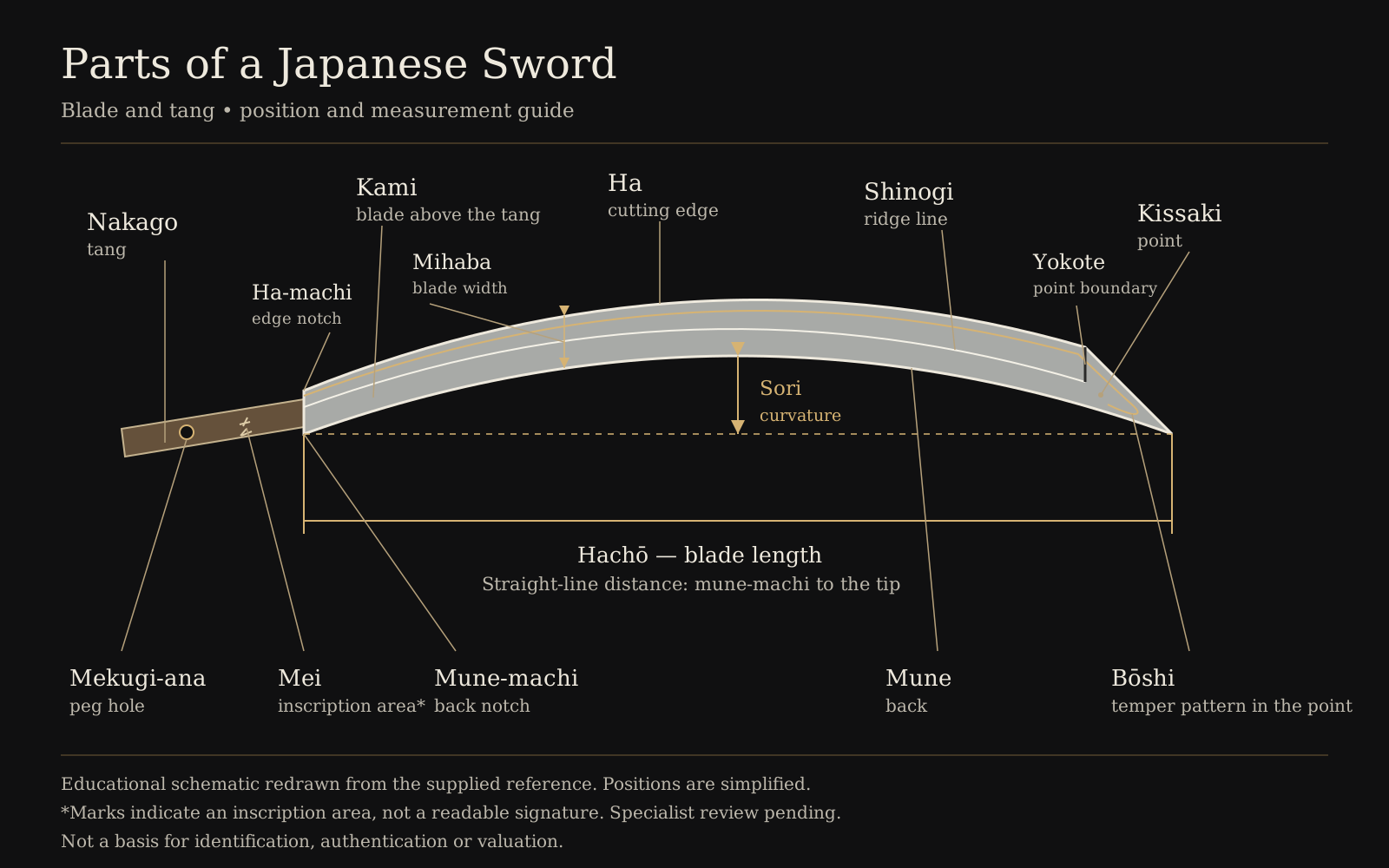
The part that fits into the hilt. The most important point of appraisal, where the maker and period are judged from the signature, date inscription, file marks (yasurime) and the shape of the tang end (nakago-jiri).
The main body of the blade, from the notches (machi) to the point. The steel, the temper pattern and the shape are all subjects of appreciation and appraisal.
The swordsmith's name cut into the tang. Prices differ greatly between signed (zaimei) and unsigned (mumei) blades. Authenticity is assessed from the handling of the chisel.
The hole for the mekugi, the peg that secures the hilt. Its position and number are read to determine whether the blade has been shortened (suriage) or altered.
The notch on the edge side. The boundary with the tang. It serves as an indicator of the degree of loss from polishing.
The notch on the back side. Paired with the ha-machi, it is the starting point for the length of the blade.
The width from the edge to the back. The shape is judged from the ratio of the width at the base (moto-mihaba) to the width near the point (saki-mihaba).
The degree of curvature of the blade. The position and depth of the curve, as in koshi-zori, kyo-zori and saki-zori, show the characteristics of each period.
The back of the blade, on the side opposite the edge. It is classified as iori-mune, maru-mune or mitsu-mune.
The straight-line distance from the mune-machi (back notch) to the tip of the kissaki (point). It is used in length-based classifications such as katana, wakizashi and tantō.
The boundary line separating the kissaki (point) from the rest of the blade.
The section of the blade beyond the yokote. Forms such as ko-kissaki, chu-kissaki, o-kissaki and ikubi-kissaki reflect the period and school.
The temper pattern hardened within the kissaki. The most important point of observation, also called the “face,” where the swordsmith's individuality appears most vividly.