
When you look at Japanese swords in a gallery, you notice that the object labels give different names: “tachi,” “katana,” “wakizashi,” and “tanto.” Most have single-edged blades, but their shapes are not uniform. Some examples have pronounced curvature, while others, like tanto, look almost straight. At first it is hard to tell what differs and how. This article sets out an order for calmly telling the four names apart using two clues: approximate length and how the sword is worn. The photographs shown are all of works in museum collections and are not items handled by our company. Please note at the outset that, because the shooting conditions differ, the scale is not uniform, and comparing sizes on screen does not amount to comparing the actual lengths.
The name is not decided by length alone
First, remember that the distinction between tachi and katana (uchigatana) is not simply length. A tachi is suspended from the waist with its edge downward; a katana is inserted into the sash with its edge upward. The different orientation and method of wearing result in differences in the fittings on their mountings (Hyōgo Prefectural Museum of History: Tachi and Katana; Japanese Sword Museum: Types and Construction).
Wakizashi and tanto, on the other hand, are divided mainly by length in the current classification. However, sources vary in how they express the boundaries, and the handling of “or more” and “or less” sometimes overlaps. The figures of 1 shaku and 2 shaku are guides for classification, not strict dividing lines. For individual works, the surest approach is to give priority to the official name given by the holding museum.
Comparing the four names side by side
The table below is a simple list to keep in the back of your mind when viewing. The length figures are approximations in the traditional shakkanho system of measurement: 1 shaku is about 30.3 cm, and 2 shaku is about 60.6 cm.
| Type | Approximate length | How it is worn | Points to check alongside on the label |
|---|---|---|---|
| Tachi | No fixed range; cannot be distinguished from a katana by length alone | Suspended from the waist with the edge down | Date of production, whether it has been shortened (suriage), position of the signature (mei) |
| Katana (uchigatana) | Many explanations give roughly 2 shaku (about 60.6 cm) or more as a guide | Thrust through the sash with the edge up | Any note that it may originally have been a tachi |
| Wakizashi | Many explanations give 1 shaku or more but less than 2 shaku (about 30.3–60.6 cm) as a guide | Thrust through the sash alongside the katana | Pairing with a katana, whether there is a koshirae |
| Tanto | Many explanations give less than 1 shaku (about 30.3 cm) as a guide | A short blade thrust through the sash | Carvings, design of the koshirae |
The table gives representative guides only. There are quite a few exceptions near the boundaries, such as the kodachi, a shorter tachi, and the sunnobi tanto, a somewhat longer tanto. Note too that the divisions of about 30 cm and about 60 cm are merely approximations that restate 1 shaku and 2 shaku in an easy-to-grasp way. When the name on an object label seems not to match the guide figures, take the museum's name as the standard.
Blade length and overall length are different figures
A common difficulty in comparing lengths is knowing the measurement's endpoints. In Japan, blade length is described as the straight-line distance between the point and the machi, or notch (Gifu Prefecture: Sword Terminology). The nakago, or tang inside the hilt, is excluded.
Overseas museums may list measurements using several standards. For example, the Metropolitan Museum's tachi page records an overall length including the mounting of 104.2 cm and a cutting-edge length of 72.1 cm (The Met 36.25.1695a, b). The latter corresponds to what is termed blade length in Japan. Comparisons in this article use the museums' cutting-edge or blade-length figures consistently. Mixing different measurement standards can make the same sword appear to be a different object.
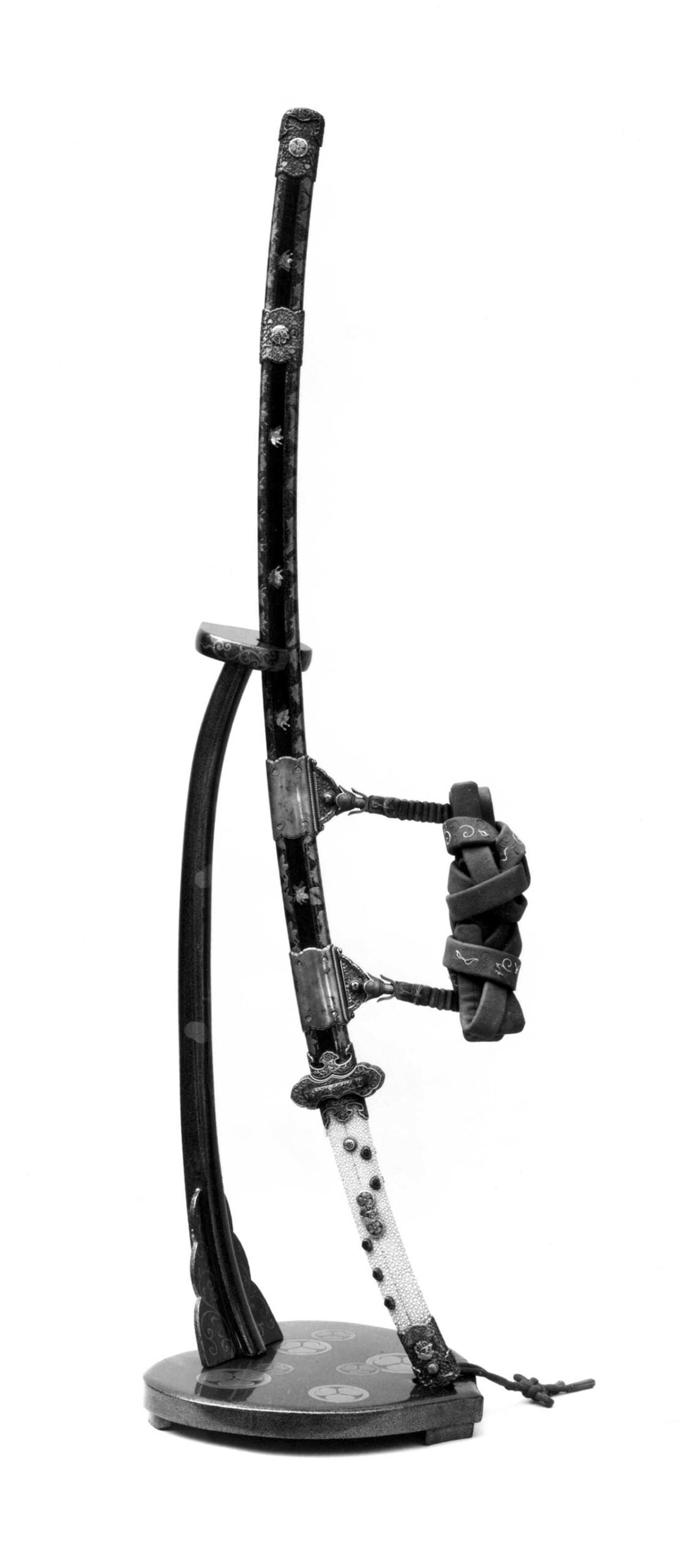
The Metropolitan Museum of Art, 36.25.1695a, b / CC0 / Collection Record
This photograph shows a tachi koshirae; the blade is not shown because it is housed in the saya. The metal fittings and cords attached to the saya are the mechanism for suspending it from the waist. Length cannot be measured from a photograph, so always check dimensions against the entry on the work's page.
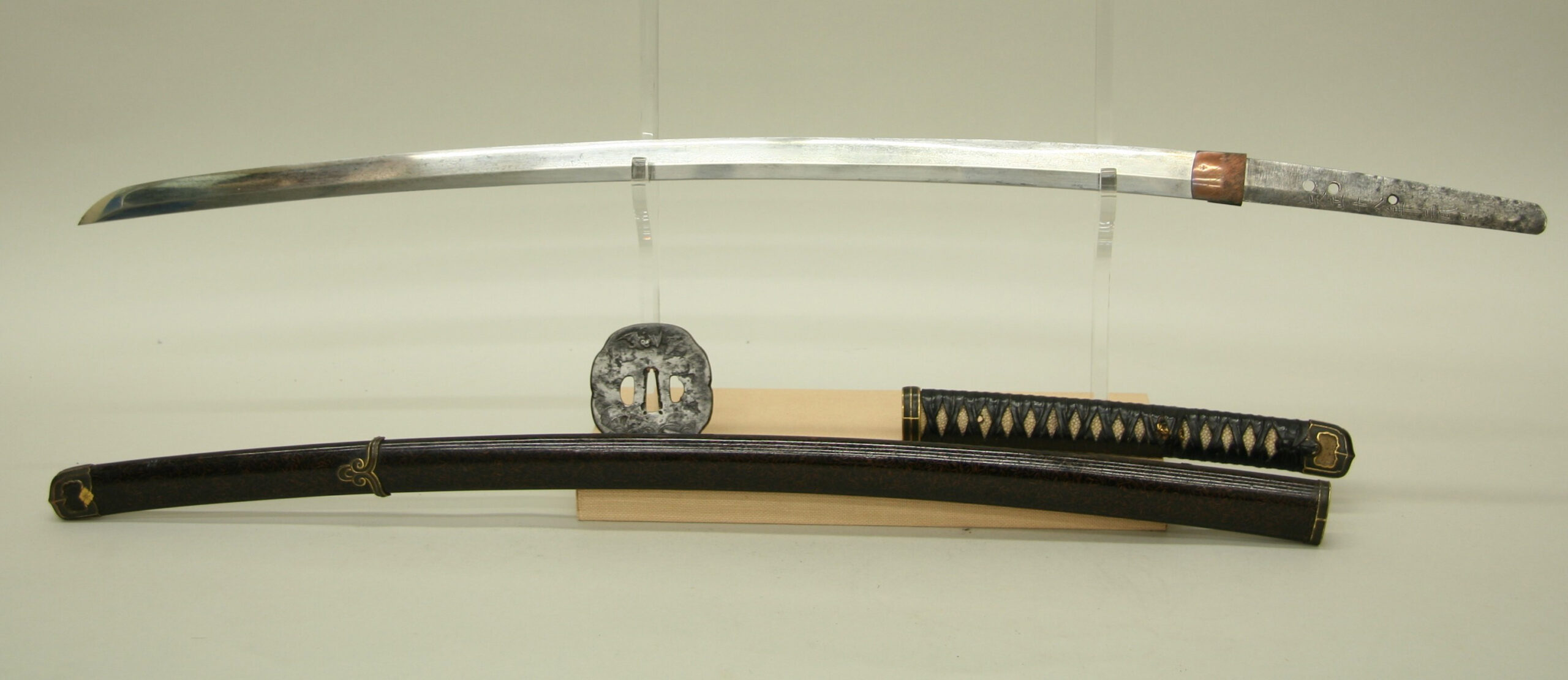
The Metropolitan Museum of Art, X.11 / CC0 / Collection Record
This katana (uchigatana) is photographed with its blade and mounting side by side. Its recorded cutting-edge length is 70.2 cm (The Met X.11), close to the tachi's 72.1 cm. This makes clear why length alone cannot distinguish the two.
For Tachi and Uchigatana, Also Look at How They Were Worn and Their History
When lengths are similar, the wearing method and history are useful clues. Tachi mountings have suspension fittings, while uchigatana mountings are made for insertion into a sash. Some blades originally made as tachi were later shortened and reshaped through suriage and came to be used as katana (Japanese Sword Museum: Types and Construction).
Signature position is also considered a clue, but known exceptions mean it cannot be conclusive by itself. The basic approach is to compare several kinds of information, including form, inscription, date and provenance (Hyōgo Prefectural Museum of History: Tachi and Katana). At the appreciation stage, do not infer authenticity or value from a single factor such as an inscription or measurement.
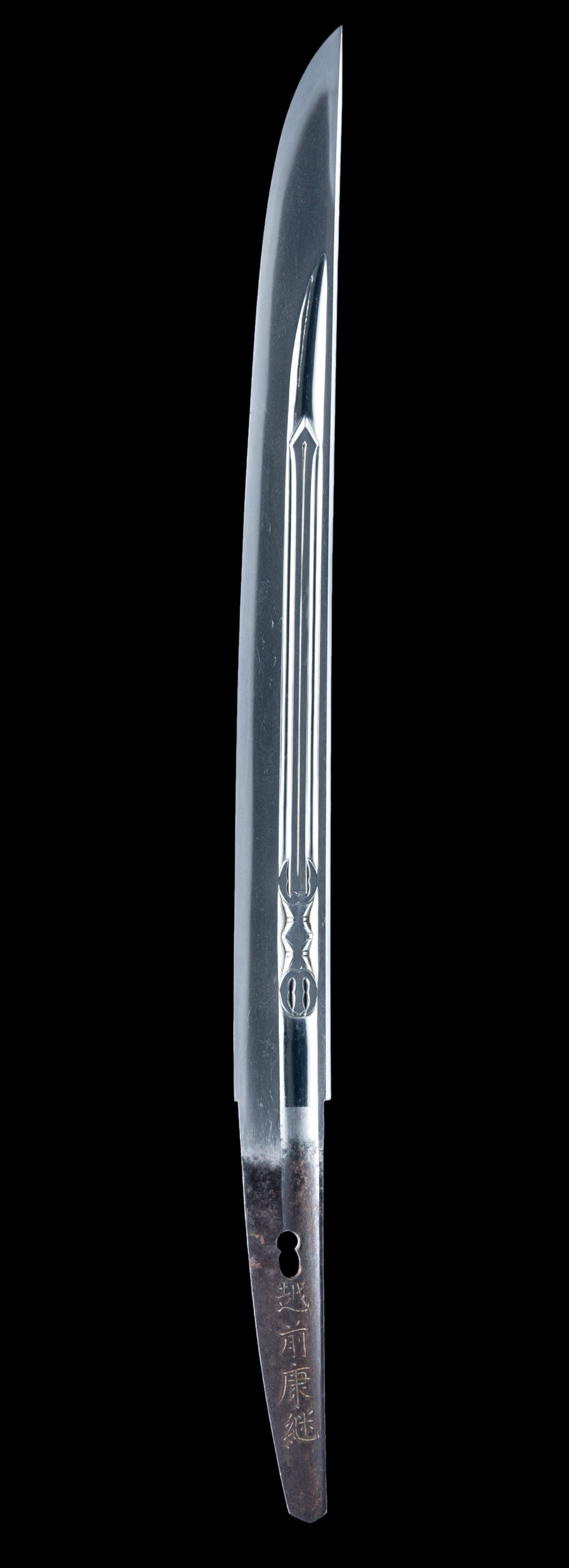
The Metropolitan Museum of Art, 29.100.1370a–c / CC0 / Collection Record
This is a wakizashi blade. Its cutting-edge length is recorded as 37.1 cm, within the guideline range of at least one shaku and less than two shaku (The Met 29.100.1370a–c).
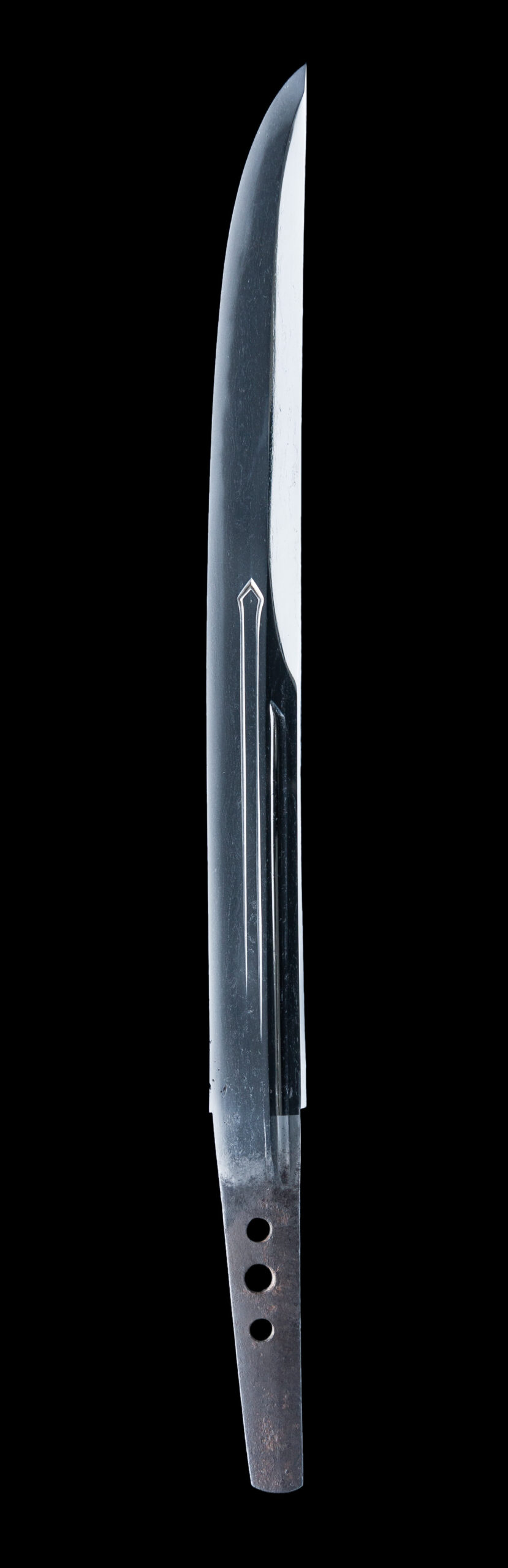
The Metropolitan Museum of Art, 29.100.1362a–c / CC0 / Collection Record
The tantō has a cutting-edge length of 27.9 cm, within the guideline of less than one shaku (The Met 29.100.1362a–c). Comparing the four examples shows that differences in the museums' recorded blade lengths broadly correspond to differences in terminology.
Observation Checkpoints in the Exhibition Room
- First, read the formal title on the work's label and confirm whether it is a tachi, katana, wakizashi, or tanto.
- Next, look for the stated length and check whether it is the blade length or the overall length.
- If a koshirae is displayed together with the blade, observe whether it has fittings for suspension or a form meant to be thrust through the sash.
- Read the explanatory text for any mention of suriage or provenance, and consider whether the present form is the original one.
- Finally, jot down your own impressions in short phrases such as “shorter than I expected” or “shallow curvature.”
Loosely settling on an order like this reduces oversights and makes it easier to retrace your memory later. Note that touching the blade or disassembling a sword yourself is outside the scope of appreciation. Simply following it slowly with your eyes from outside the display case is more than enough to enjoy it.
A Guide to Your Next Viewing
Once you can distinguish names and dimensions, add the question of when a sword was made. Even among objects called katana, characteristic forms change by period. Period divisions are summarized in Kotō, Shintō and Shinshintō: The Differences. For an overall sequence of moving through a gallery and choosing where to look first, see Enjoying Japanese Swords. Bringing together name, length and date gradually reveals more in the brief wording of a label.