
Gallery labels may show regional names such as Bizen and Sōshū, indicating where a sword is thought to have been made and the technical lineage to which it is attributed. Five regions are well known for kotō: Yamato, Yamashiro, Bizen, Sōshū and Mino, collectively called the Five Traditions (Hyōgo Prefectural Museum of History: Sword Production Regions). This term groups five major kotō traditions; it does not divide every Japanese sword into five exhaustive categories. Here they are starting points for pausing before an individual sword, rather than a chart to memorize. For chronology, also see Kotō, Shintō and Shinshintō: The Differences.
A Separate Matter from Schools of Swordsmanship
Tradition may suggest a school of swordsmanship, but here it means a lineage of blade-making techniques. Nagoya Touken World Museum also explains the Five Traditions as regional sword-production techniques that developed independently (Nagoya Touken World Museum). Distinguishing makers' lineages from users' martial schools makes regional names on labels easier to read.
Where Did the Gokaden Develop?
What appears on labels are the names of the old provinces. Because the extent of the old provinces does not coincide exactly with present-day prefectural borders, please use the table below as a rough guide to “approximately where” each one was.
| Tradition (old province name) | Approximate present-day area | Main center |
|---|---|---|
| Yamato tradition (Yamato Province) | Around Nara Prefecture | Nara |
| Yamashiro tradition (Yamashiro Province) | Around southern Kyoto Prefecture | Kyoto |
| Bizen tradition (Bizen Province) | Around southeastern Okayama Prefecture | Osafune, on the lower Yoshii River |
| Sōshū tradition (Sagami Province) | Around Kanagawa Prefecture | Kamakura |
| Mino tradition (Mino Province) | Around Gifu Prefecture | Seki |
(Hyōgo Prefectural Museum of History)
Production Regions Are Not Closed Boxes
The Five Traditions are not five unrelated boxes. Sōshū developed around Kamakura with the migration of smiths from Yamashiro and Bizen. Mino was also shaped by smiths arriving from different regions. In the shintō period, production spread to Edo, Osaka, Kyoto and castle towns elsewhere (Hyōgo Prefectural Museum of History).
Later examples also suggest movement between traditions. The Metropolitan Museum describes a daishō pair made by Taikei Naotane in 1839: although by the same maker, the katana is in Bizen style and the wakizashi in Sōshū style (The Metropolitan Museum of Art). This illustrates later smiths studying different traditions. A region's name is a clue to maker and style, not a guarantee that every sword associated with it looks the same.
Looking Closely at a Single Blade
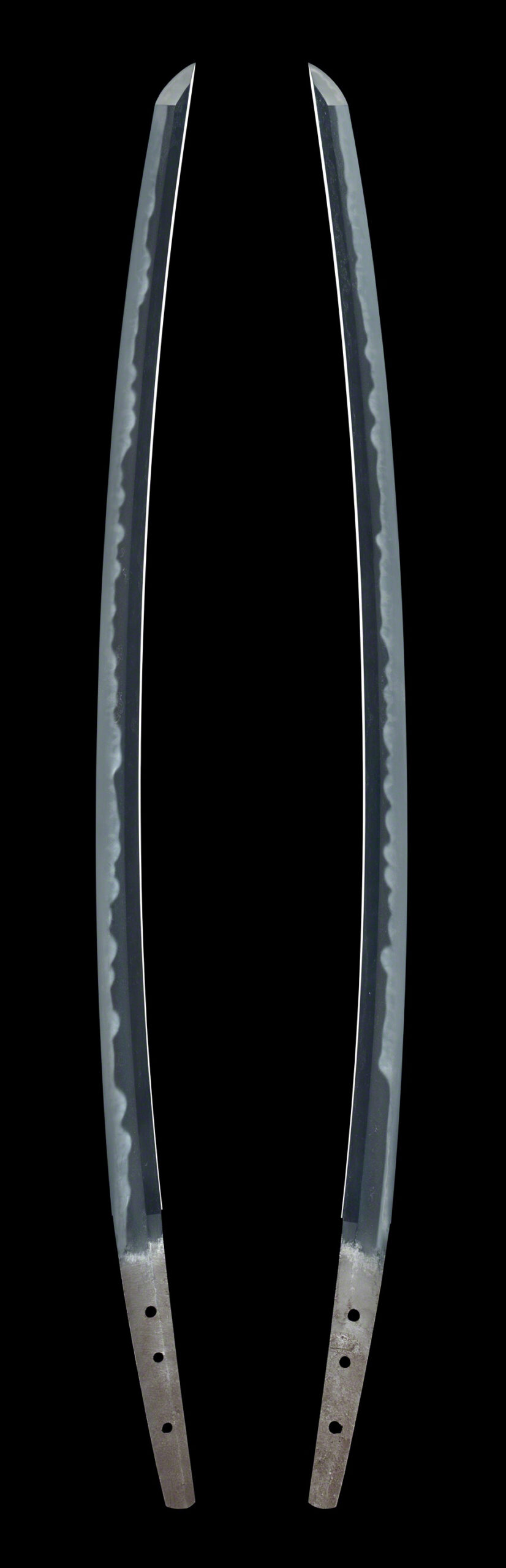
Tokyo Fuji Art Museum, Object 01614 / CC0 / Collection Record
Tokyo Fuji Art Museum officially describes its Fukuoka Ichimonji tachi as an Important Cultural Property of the Kamakura period, 13th century, with blade length 72.0 cm, a broad blade and jūka-chōji mixed with kawazuko-chōji (Tokyo Fuji Art Museum). The photographs show both faces of the same sword, with a pale band waving along the curved blade and three peg holes visible in the tang. The band marks the approximate temper-pattern area, not its precise boundary. Leaving the specialist terminology to the commentary, first follow where the peaks grow larger and smaller, from the tang end toward the point. The name Bizen may become associated in memory with this flowing pattern.
Checkpoints to Confirm at an Exhibition
- Read the province name or production-region name on the label first, and check in the correspondence table roughly where that is today
- Follow the continuous line of the hamon with your eyes, in order from the side near the nakago toward the kissaki
- Shift your standing position slightly and check whether the appearance of the jigane and hamon changes (follow the museum's guidance)
- Compare two or more works by different makers that carry the same province name, and notice the differences
- Do not remove the hilt or scabbard yourself. Read the nakago and the inscription only within the range shown in the display or its explanation
- Do not try to identify a lineage from visual impression alone; limit yourself to putting into words “where they are alike and where they differ”
Toward Your Next Viewing
The Five Traditions provide regional landmarks for finding your own route through a large gallery, rather than a scale for scoring works. On your next visit, note the province of one work that interests you, then look for another from that province at a different museum. With each comparison, the regional name becomes a memory as well as a category. For a viewing sequence, also see Enjoying Japanese Swords.