
On a display-case label, a good deal of information is packed into one short line, such as “Tachi, mei ◯◯ (gō ◯◯).” The maker's name, the characters inscribed, the name given in parentheses—these are not the same kind of information. This article sets out the steps for reading a label line by dividing it into its separate fields. It is not about judging authenticity or about selling; it is an article for calmly reading the label in front of you.
A Single Label Line Is a Bundle of Information
Kyoto National Museum explains that tang inscriptions can include not only the maker but also residence, production date, later appraisal or alteration history, and owner information (Kyoto National Museum). Mei therefore does not mean only a swordsmith's signature. Conversely, a personal name in an object's title is not necessarily inscribed on the sword.
Reading Field by Field
Whether there is an inscription, and whose work the sword is considered to be (attribution), are separate pieces of information. If you first separate these two, the remaining fields also become easier to sort out.
| Type of information | Clues on the label | Points to note when reading |
|---|---|---|
| Presence or absence of an inscription | “Mei ◯◯” / “Mumei” (no inscription) | Information on whether characters are inscribed or not. An attribution may be given even when the sword is mumei |
| Attribution | The name in the maker field; qualifying expressions such as “den” (attributed to) | Separate information from the presence or absence of an inscription. The maker field is sometimes blank |
| Date inscription (nenki) | An inscription of a date in the form “year ◯◯, month ◯, day ◯” | Read the era name, month, and day as originally written. Do not confuse months and days of the old lunar calendar with the modern calendar |
| Gō / meibutsu name | “Gō ◯◯” or “Meibutsu ◯◯” in parentheses | A name that distinguishes one particular blade. A separate field from the maker's name |
| Later records | “Kinzōgan-mei” (gold-inlaid inscription) | Kinzōgan-mei is the name of a technique in which an inscription is applied by inlaying gold. Check the explanation for who recorded it and when |
Example 1: The Mei and the Gō Are in Separate Fields
Kyoto National Museum's published object list includes the entry 太刀 銘 波平行安(号笹貫), “Tachi, mei: Naminohira Yukiyasu (gō: Sasanuki)” (Kyoto National Museum). The mei in the first part gives the characters inscribed on the sword; the gō in parentheses is the name that distinguishes this particular sword. Reading Sasanuki as the maker's name would shift the information by one category.
“Katana, kinzōgan-mei Honda Mino no Kami shoji / Yoshihiro Hon'a (kaō) (meibutsu Kuwana Gō),” from the same list, is an example to be read in still finer divisions. “Kinzōgan-mei” refers to the way the inscription was applied (the technique); “Honda Mino no Kami shoji” is information about ownership; and the kaō in “Hon'a (kaō)” is a kind of signature. Technique, ownership, and signature are each separate pieces of information, and they cannot be lumped together as the same thing as a signature inscribed by the swordsmith himself.
Example 2: “Mumei” and a Meibutsu Name Coexist
Kyoto National Museum's collection database lists an unsigned katana named Meibutsu Shimazu Masamune, dated to the Kamakura–Nanbokuchō period, 14th century (Kyoto National Museum Collection Database). A celebrated sword name can be passed down without an inscription. Do not equate a personal name in an object title with characters on the actual blade: this is fundamental when reading unsigned works. For unsigned swords themselves, see Can an Unsigned Japanese Sword Be Sold?.
Example 3: The front and back serve different roles
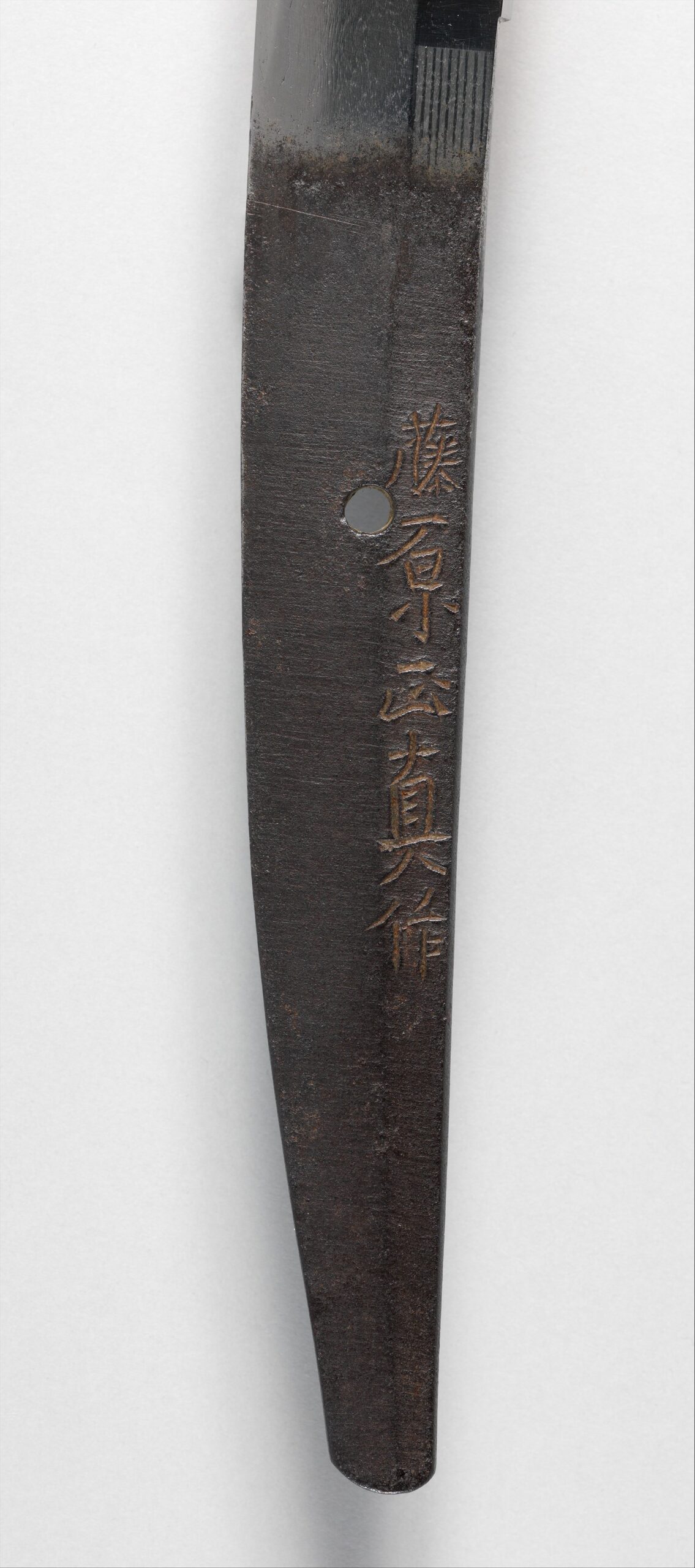
The Metropolitan Museum of Art 2001.574 / CC0 / Collection Record
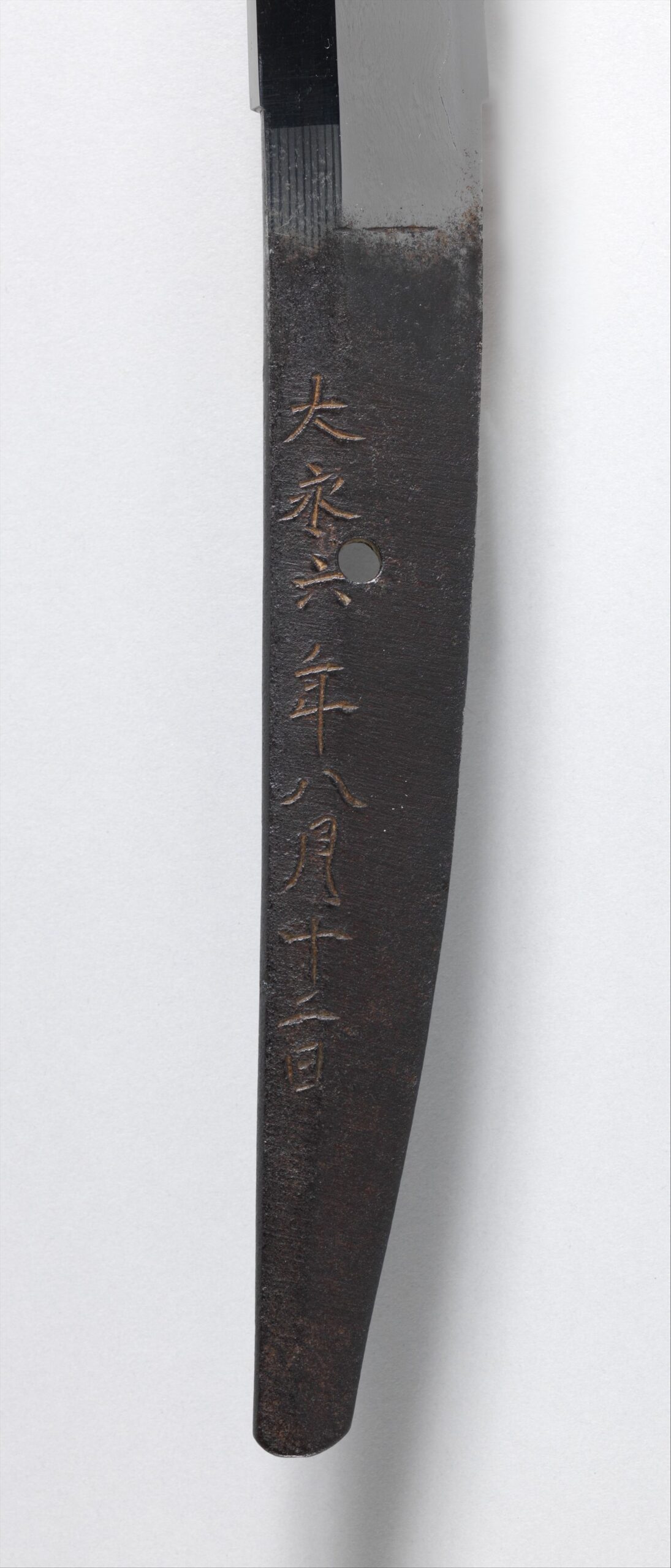
The Metropolitan Museum of Art 2001.574 / CC0 / Collection Record
The Metropolitan Museum publishes object 2001.574 as by Masazane, dated 1526. Its romanized inscription descriptions, compared with the photographs, can be rendered in standard characters as 藤原正真作 on one face and 大永六年八月十二日 on the other (The Metropolitan Museum of Art). Both photographs show a vertical line of characters passing near the peg hole.
In this way, the arrangement itself, with the inscription that includes the maker's name on one side and the date inscription on the other, offers a clue for checking the division of a label into fields against an actual object. The date is recorded using the era name of the time; Daiei 6 corresponds to 1526, but the month and day, the 12th day of the 8th month, follow the calendar of the time and are not the same as the date in the modern calendar. Note that being able to read an inscription and judging who made the sword are separate matters. Authenticity cannot be determined from photographs or characters alone.
The order for checking at an exhibition
- First, read the whole title of the work, and mentally separate what is inside the parentheses from what is outside
- Look for terms such as 銘 (mei, inscription), 無銘 (mumei, unsigned), 伝 (den, traditionally attributed), and 金象嵌銘 (kinzōgan-mei, gold-inlaid inscription), and decide which field the information belongs to
- If a date is given, copy it down as written in the era name (check the corresponding year later)
- If the tang is visible in the display, compare the character string in the official description with the vertical arrangement in the photograph or on the actual object
- Do not do anything to the sword yourself, such as removing the hilt or cleaning off rust
- For characters you cannot read or questions about attribution, check the exhibition commentary on the spot or ask a curator
Toward Your Next Viewing
Once you can read a label field by field, the same gallery may feel a little more expansive. Next time, divide the label of one work into four notes: inscription status, maker attribution, date inscription and sword name. Anything you cannot categorize becomes a question to research next. For what specialists check in individual works, see Determining a Japanese Sword's Authenticity: The Appraiser's Role.