
As you stand before a display case looking at the curve of a blade and the white line of its edge, the question arises: “How was this made?” There is no need to memorize the process in detail. At which stage did who take on what, and where is the result visible now? Once you grasp that correspondence, there are more places for your eye to rest, even on the same sword. Here we trace the flow from materials to mountings as a guide to appreciation.
Making iron and making swords are separate jobs
First distinguish two separate specialisms: producing iron and making a blade from it. Tatara is iron production using iron sand and charcoal; the high-quality steel portion produced is described as tamahagane. The Society for Preservation of Japanese Art Swords' Nittoho Tatara preserves the technique, trains successors and distributes tamahagane and other materials to swordsmiths (Japanese Sword Museum: Tatara Operations and Nittoho Tatara).
Tamahagane is the name of the material a sword is made from, and at the same time it is an achievement sustained by a separate craft. If you have the chance to see a lump of the raw material on display, it is worth remembering the impression of that rough, craggy lump. The gap between it and the polished blade becomes, just as it is, the weight of the processes that follow.
Selection and Forging — The Stage of Judging the Material
A swordsmith begins by selecting the raw material. Forging, construction, shaping and quenching follow, with methods varying by period, school and individual (Japanese Sword Museum: Swordmaking and Polishing). There is no universal sequence that is the sole way to make every Japanese sword.
The folding that is so often talked about is likewise not a simple yardstick on which more folds mean higher quality. How to read the nature of the material, and where to stop. The accumulation of those judgments remains as the character of the jigane (the ground area of the blade). When viewing, rather than imagining the number of folds, it is more rewarding to put into your own words impressions such as whether the grain of the ground looks fine and tight, or looks as if it is flowing.
Shaping and Quench Hardening — Where the Form and the Hamon Are Set
At the shaping stage, the overall outline of the blade, such as its length, its curvature, and the shape of the kissaki (point), is settled. The quench hardening that follows is a process that produces a difference in properties between the edge side and the ground side, and the scenery of the white pattern called the hamon also originates here. The specific conditions of the work are the craftsman’s domain, so those of us who view simply and quietly receive the result.
The knack when looking is not to see the hamon as a flat “pattern.” Is it close to a straight line, or does it undulate widely? Is the boundary between the edge and the ground crisp, or is it blurred like mist? Shift your standing position a little and check whether the appearance changes. The areas that look white depending on the polish and the way the light falls are not simply the same as the boundary of the hardened edge, and depending on the viewing conditions they can feel like a layer different from a flat pattern.
Polishing and Mountings — Another Specialty That Draws Out the Beauty
Even after a blade has been formed, its steel surface and temper pattern are not fully revealed. Polishing is a specialist skill that brings out the sword's beauty. The craftsperson who forges tamahagane into a blade is the swordsmith; the craft continues through the polisher and specialists in mountings (Setouchi City: Swordsmiths). Owners are not advised to polish or disassemble their swords themselves. Handling decisions are entrusted to specialist craftspeople and institutions.
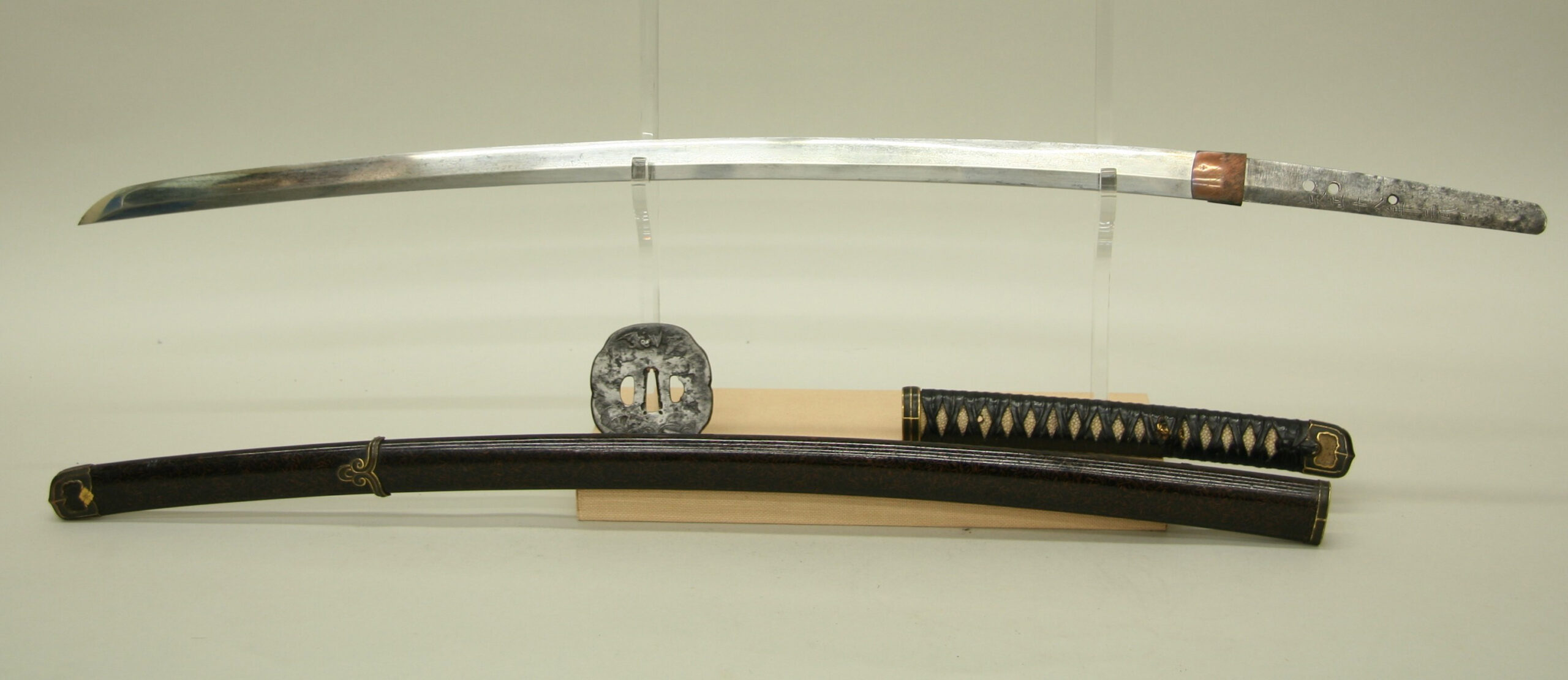
The Metropolitan Museum of Art, Open Access (CC0) / Collection Record
Mountings bring together several specialisms, including scabbards, hilts and guards. They may have been made at a different time from the blade or replaced to suit an owner's taste. Ways of viewing them are also discussed in Mountings and Sword Fittings.
| Stage | Craft mainly responsible | What becomes visible on display |
|---|---|---|
| Selection of raw material | Iron smelting / swordsmith | The foundation of the texture of the jigane |
| Forging / tsukurikomi | Swordsmith | The character of the grain of the ground |
| Shaping | Swordsmith | The overall form; the shape of the kissaki |
| Quench hardening | Swordsmith | The scenery of the hamon |
| Polishing | Polisher (togishi) | The return of light; the boundary between ground and edge |
| Making of the mountings | Scabbard, hilt, metalwork, and other trades | The combination of design and materials |
* These correspondences are a rough guide. More than one process is involved in any single visual effect.
An Order of Viewing That Recalls the Processes
At the venue, try using the order of the processes directly as the order of your gaze. First, stand back and look at the overall form. This mainly involves the shaping stage (quench hardening is also said to affect how the form comes out). Next, move closer and look at the grain of the ground. This is the result of forging and tsukurikomi. Then trace the hamon. This is the result of quench hardening. Finally, change your angle and look at how the light returns. This is the result of polishing. If mountings are displayed alongside, take your time looking at them last, as the work of other trades.
Three lines are enough for observation notes. On the first line, the overall impression; on the second, what you noticed in the ground and the hamon; on the third, the feel of the materials of the mountings. It does not matter if you do not know the proper names. What calls for care here is not to decide the maker, the date, the authenticity, or the value from the patterns you saw or the impression of a photograph alone. Those belong to a domain examined through separate procedures and documents, and thinking of them apart from the enjoyment of viewing actually lets you look more at ease.
I think the benefit of knowing the processes lies less in gaining knowledge than in becoming able to imagine how many people’s time has accumulated in the single sword in front of you. The next time you enter an exhibition room, try, just once in front of the blade, recalling the iron as it was when it was still raw material.