
Utsuri is a pale, mist-like effect visible in the body of a Japanese sword's steel, distinct from the hamon. The Japanese Sword Museum of the Society for Preservation of Japanese Art Swords describes it in these terms and identifies it as a feature to appreciate in Bizen swords (Japanese Sword Museum). With the edge downward, utsuri appears in the steel on the spine side of the hamon. Because it is faint, lighting and viewing angle can make it difficult to discern. It is not unusual to be unable to see it even when the commentary mentions it.
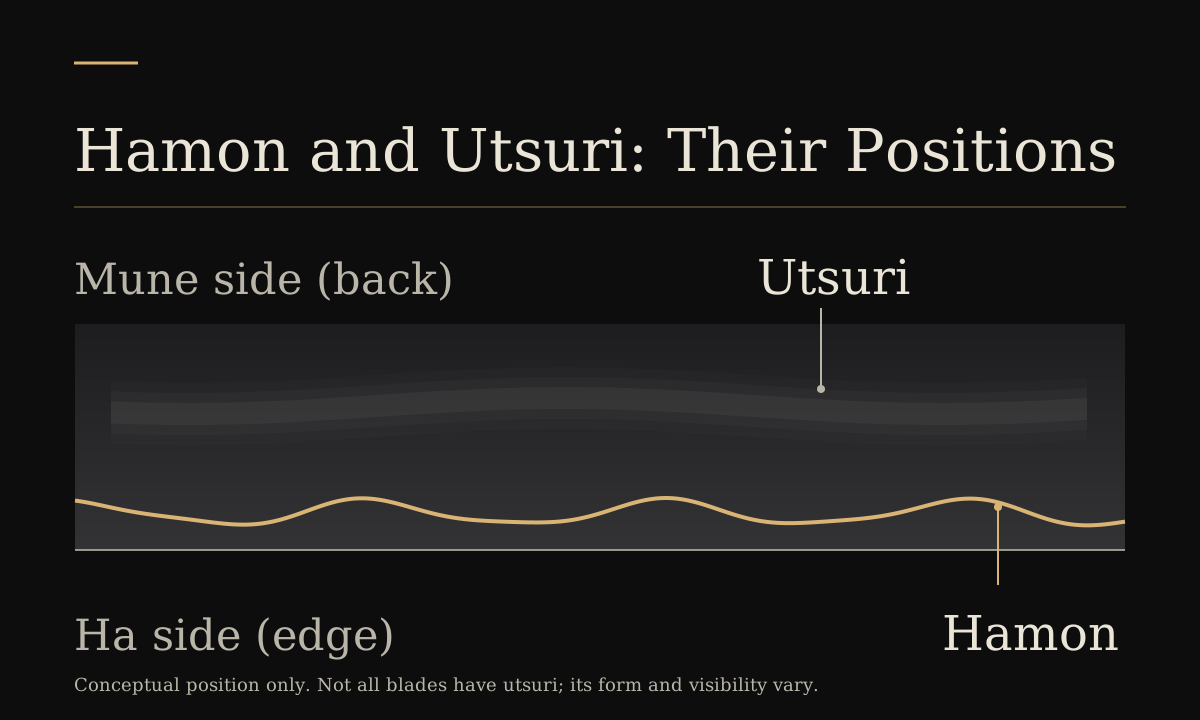
Utsuri Does Not Appear in Only One Way
Gifu Prefecture's sword explanation calls rod-like utsuri bō-utsuri (Gifu Prefecture). Kōchi Castle Museum of History describes the utsuri of Imamura Kanemitsu as midare-utsuri (Kōchi Castle Museum of History). These examples show that utsuri has appearances beyond straight bands.
Although utsuri is highlighted as a feature of Bizen swords, not all Bizen swords have it. Its presence does not by itself establish that a sword is Bizen. Regional characteristics are outlined in the Five Traditions.
Why It Is Hard to Judge from Photographs
Utsuri is an effect that appears in the ji of the blade itself. However, in displays seen through a glass case or in photographs, reflections of the lighting or the light used when photographing can overlap the blade as a white band. Even if it looks similar, you cannot decide from an image alone whether it is utsuri. From a photograph, please go no further than saying “there is a whitish band-like area.” As for whether it is utsuri, it is safest to rely on what is stated in the exhibition commentary or the object data.
Record in Three Steps: Commentary, Location, and How It Looked
When looking for utsuri, we suggest recording the following three things separately.
- Check whether the exhibition commentary or object data mentions utsuri (bō-utsuri, midare-utsuri, etc.).
- If it is mentioned, work out roughly where to look, focusing on the ji away from the hamon.
- Write down whether you felt you could see it on the spot, or could not make it out under those conditions.
For example, write it as follows.
- “Commentary: midare-utsuri / Location: the ji on the mune side of the hamon / Myself: faintly visible when I lowered my eye level”
- “Commentary: utsuri / Myself: could not make it out under this lighting”
A record that you could not make it out is not evidence that there is no utsuri. It becomes a clue for the next time you look. Please do not bring in any device for shining light or touch the case. Limit what you try to changing your distance and eye level.
How It Connects with the Hamon and Jigane
First distinguish the hamon's form from the steel's surface texture. Then look for a faint effect overlying the steel. This sequence makes utsuri easier to place in context. The basics are summarized in Viewing Hamon and Jigane. The presence or form of utsuri alone cannot determine a sword's origin, maker or value.